Write a sentence. Get a working agent system.
Krelvan turns plain English into real agents that act across your tools and run on your schedule. Extend it from an open Git registry, or publish your own inspectable entry through the registry review process.
Start with a goal. Run it on your own machine.
Describe what you want done. Krelvan plans the agent, shows it to you, and runs it on your own machine.
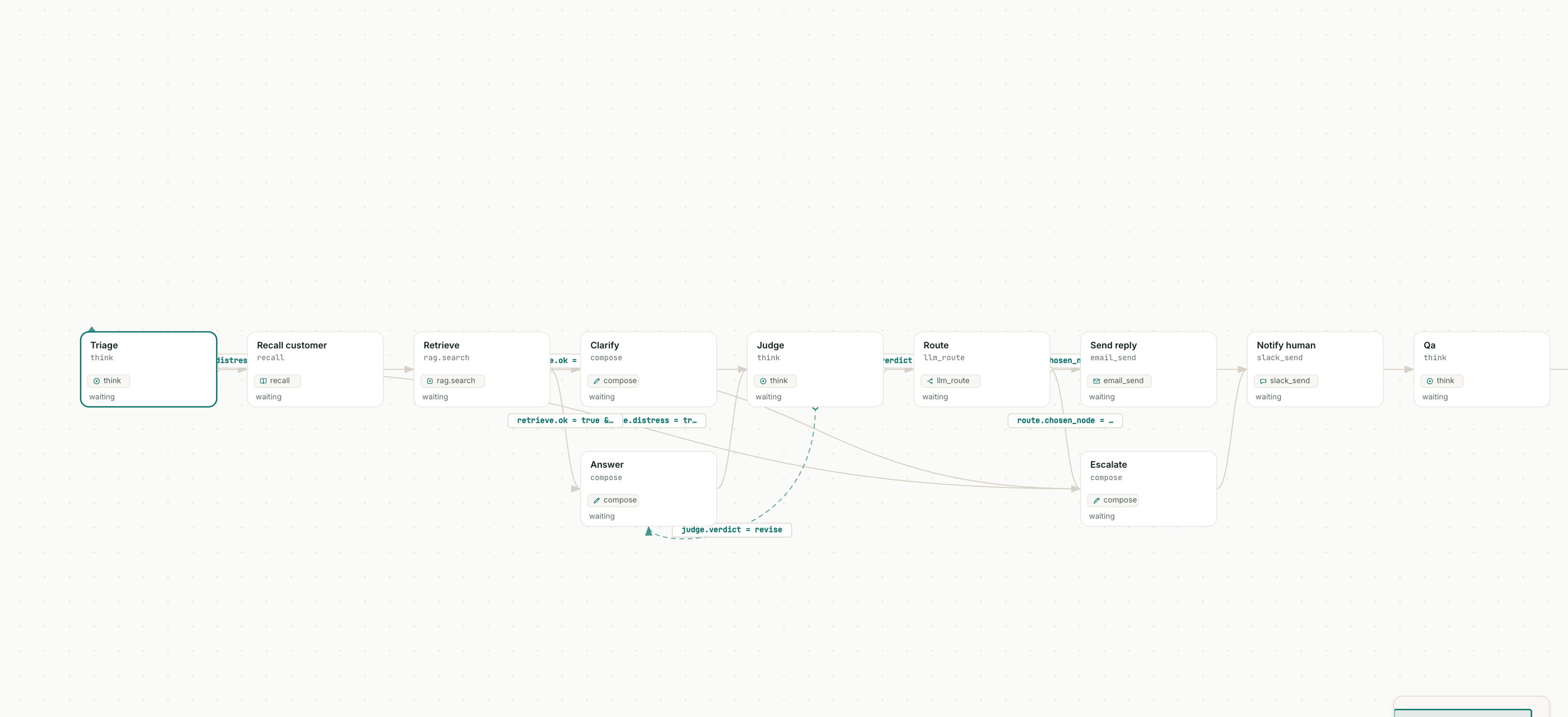
The canvas is the runtime
What you see is what runs.
Every node is a real step, every edge a real branch, and each run replays over the same recorded run — so the graph is not a diagram of the agent, it is the agent.
Output where you live
One result. Deliver it through supported channels.
The Agent Inbox works out of the box. Email, Telegram, Slack, webhooks, and other configured connectors can deliver the same output without moving execution to our website.
Why Krelvan
A framework gives you parts. Krelvan gives you the whole working system.
You can wire these layers yourself in a raw agent framework. Krelvan provides an integrated, inspectable implementation you can run and evaluate.
Not a wrapper
The infrastructure underneath.
Full run history, failure diagnosis, human control, and process isolation are built into the current system, so you can focus more of your work on domain logic.
Every step is a real recorded event. The canvas, run history and status views are all pure reads of it — so you can scrub back through any run, step by step, and what you see is exactly what executed.
Read how it works →When a run fails, Krelvan reads its full history to diagnose why, drafts a corrected agent, and re-runs it — and the repair attempt is recorded too, pass or fail.
Read the details →Describe an outcome; get a validated, typed agent graph. The model is a compiler into a manifest the kernel runs — it never executes free-form code.
See how building works →Dial autonomy per step — suggest, act-with-veto, full. It pauses before the steps you gate and shows the exact action, not a summary.
Read about approvals →Untrusted TS plugins run with restricted process permissions, brokered network access, and secrets injected only at the destination.
Inspect capabilities →Episodic, semantic and trust-aware memory with provenance. Local embeddings can run through Ollama.
Inspect the advisor →Anthropic, OpenAI, Gemini, Groq, Mistral, any OpenAI-compatible endpoint, or Ollama locally. Configure the provider in your installation.
Compare providers →Cron and interval schedules run agents unattended. The downloaded application includes its own admin setup, sessions, and request protection.
Read self-hosting guidance →Straight about the edges
What this is — and what it isn't.
- A self-hostable, open-source platform for real agents that research, draft, and act across your tools — describe an outcome, get a working multi-agent system.
- Output that reaches you where you live: the Agent Inbox out of the box, or delivered to email, Telegram, Slack, and more. Runs on any LLM provider, or fully local.
- Infrastructure you own: your data, your machine, an auditable record of every run. The cloud is optional, not the product.
- Not a hosted SaaS with an open-source husk — the whole thing runs on your box.
- Not magic. An agent can still be wrong; that's why the risky steps pause for your approval and every run keeps an auditable record you can replay.
- Not finished. This is an early release — we mark exactly which parts are battle-tested so you can judge the rest for yourself.
Ready when you are
Start building.
Open source, self-hosted, yours to keep. Pick a lane — each sized to how much you want to commit right now.
One version-pinned command boots the API + web UI on localhost:3100. Docker and an inspectable tarball are also available.
npx krelvan@0.1.5It's all open — the builder, the marketplace, the capabilities. Star it if it's your kind of thing.
Star on GitHubOpen a real registry manifest before deciding whether to install it.
Inspect it →